

0%

You died.
Death, however, is only the beginning.Now at the gates of judgment, your soul's ultimate fate reveals itself with piercing clarity:A way home.Cast out.Torment without end.Rapture, pure and blinding.Yet you do not pass on. Something is broken. The only choice left is to wander the in-between.
Like countless others stranded here, you struggle to maintain your form—channeling spirit energy from anything, and anyone, around you. But where others have fallen from grace, your resolve remains unshattered.
Build your domain and arise as a Noble Lord, forging bonds with souls of the mighty, the cunning, the desperate, and the righteous. In these planes of Limbo, the path of survival is clear: Reap your enemy's souls before they can harvest yours.But peace is fleeting, and another challenger always awaits...
Strike first. Your eternal conquest in Neo Noble begins now.
Survival in the planes of Limbo requires a few key components - your deck to Channel souls and Summon spirits, and Dominance coins to mark your resolve on the battlefield.

Each card in Neo Noble belongs to one of four Prime Fates, which represent the destiny that awaits souls in the afterlife. These Fates shape your deck's strategy and playstyle.
A brand given to Souls bound to an eternity of torment. HellBound cards are influenced by the Reap Pile, power, and winning battles at any cost.

A brand given to Souls bound to be cast into the Void as ghosts. GhostBound cards are influenced by the Graveyard, bounce, and revealing what's hidden on the board and hand.

A brand given to Souls bound to reincarnate back to their home world. EarthBound cards are influenced by the Channel, cycle, and go wide on the battlefield.
A brand given to Souls bound to ascend in rapture. HeavenBound cards are influenced by Dominance, protection, and playing high cost cards.
There are four types of cards in Neo Noble, each with their distinct role and effects.
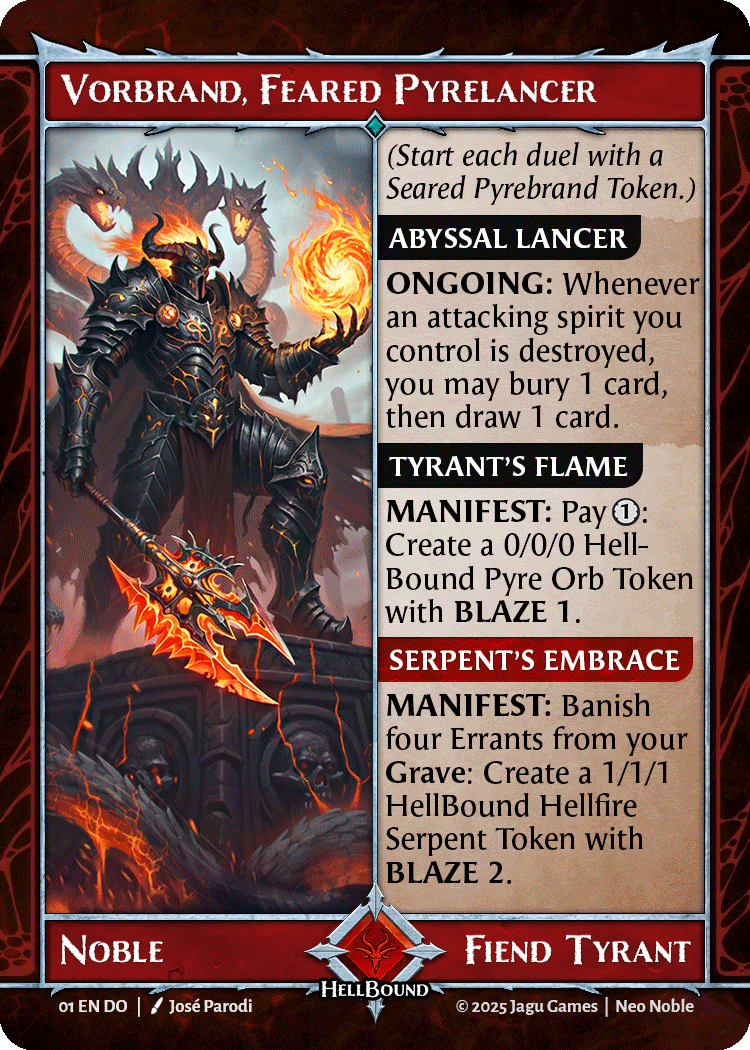
Your leader, always active with multiple effects
Cannot be destroyed or moved from Noble Zone
Can be targeted by card effects
Do not have battle stats (cost/power/resolve)
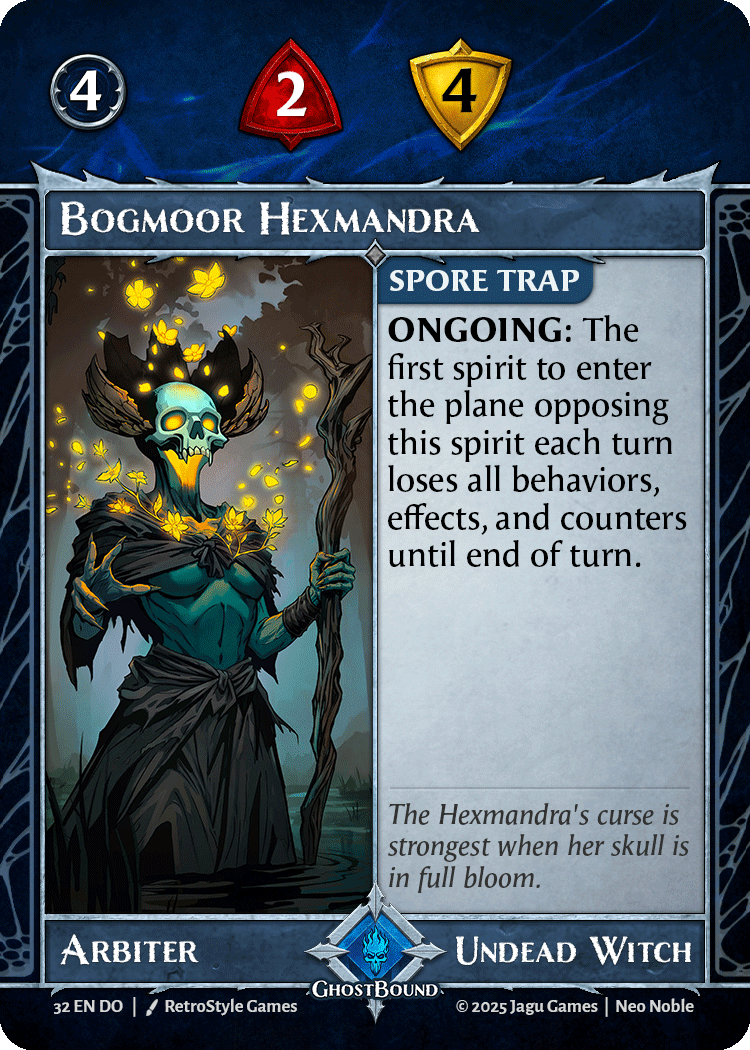
Powerful spirits with activated and passive effects
Shatterproof — survives when a stack Shatters, but receives Stun status
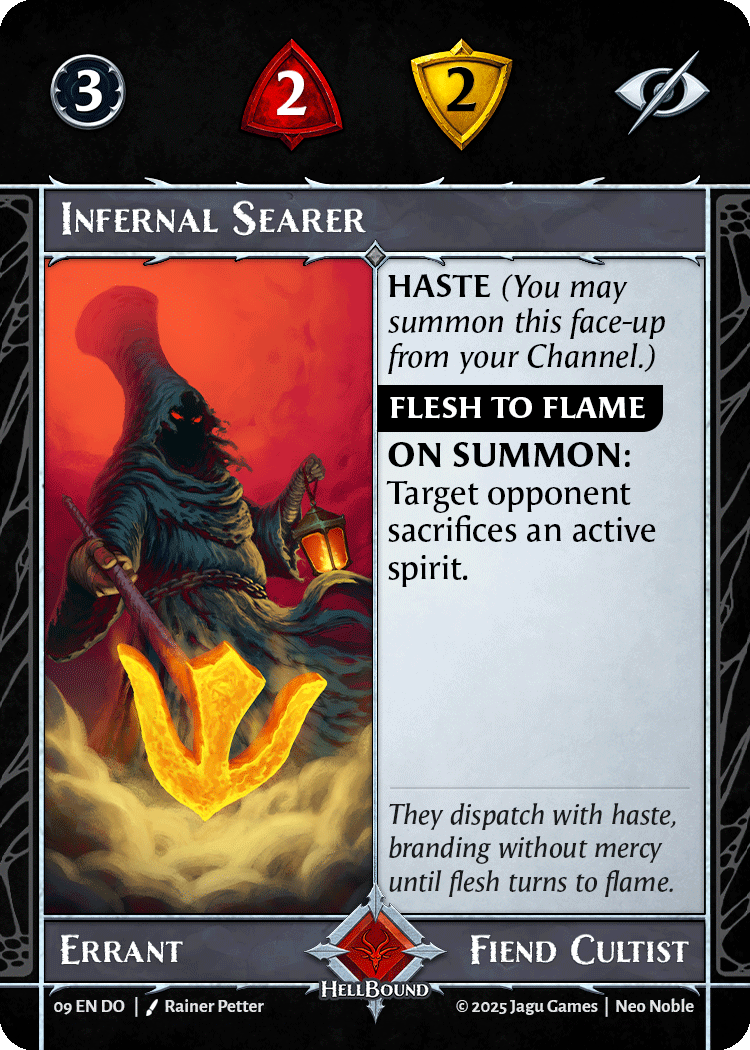
Fractured spirits with one-time effects upon being summoned
* Effects may linger even after these spirits are summoned
Destroyed when a stack Shatters (sent to Graveyard)
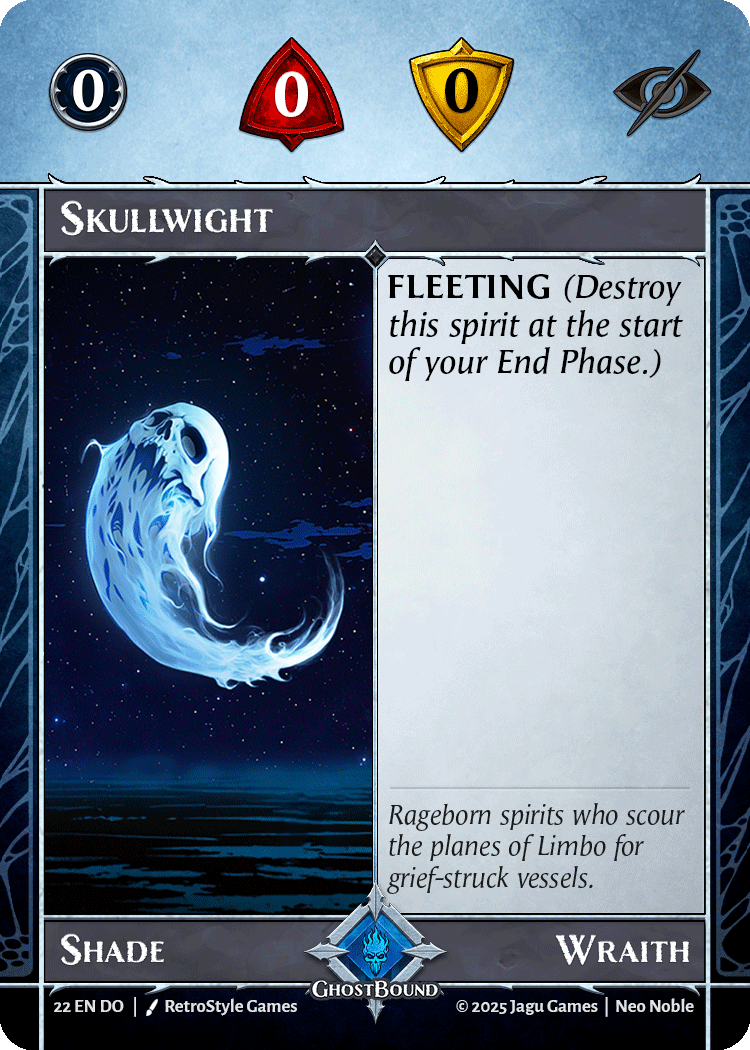
Temporary spirits created by card effects (equivalent to tokens in other card games)
Cannot enter the Grave
Destroyed when a stack Shatters (Banished from the game)
Neo Noble's gameboard (a.k.a. playmat or play area) consists of seven main zones. These zones determine how a player manages resources, summons cards, battles, and tracks their victory points.
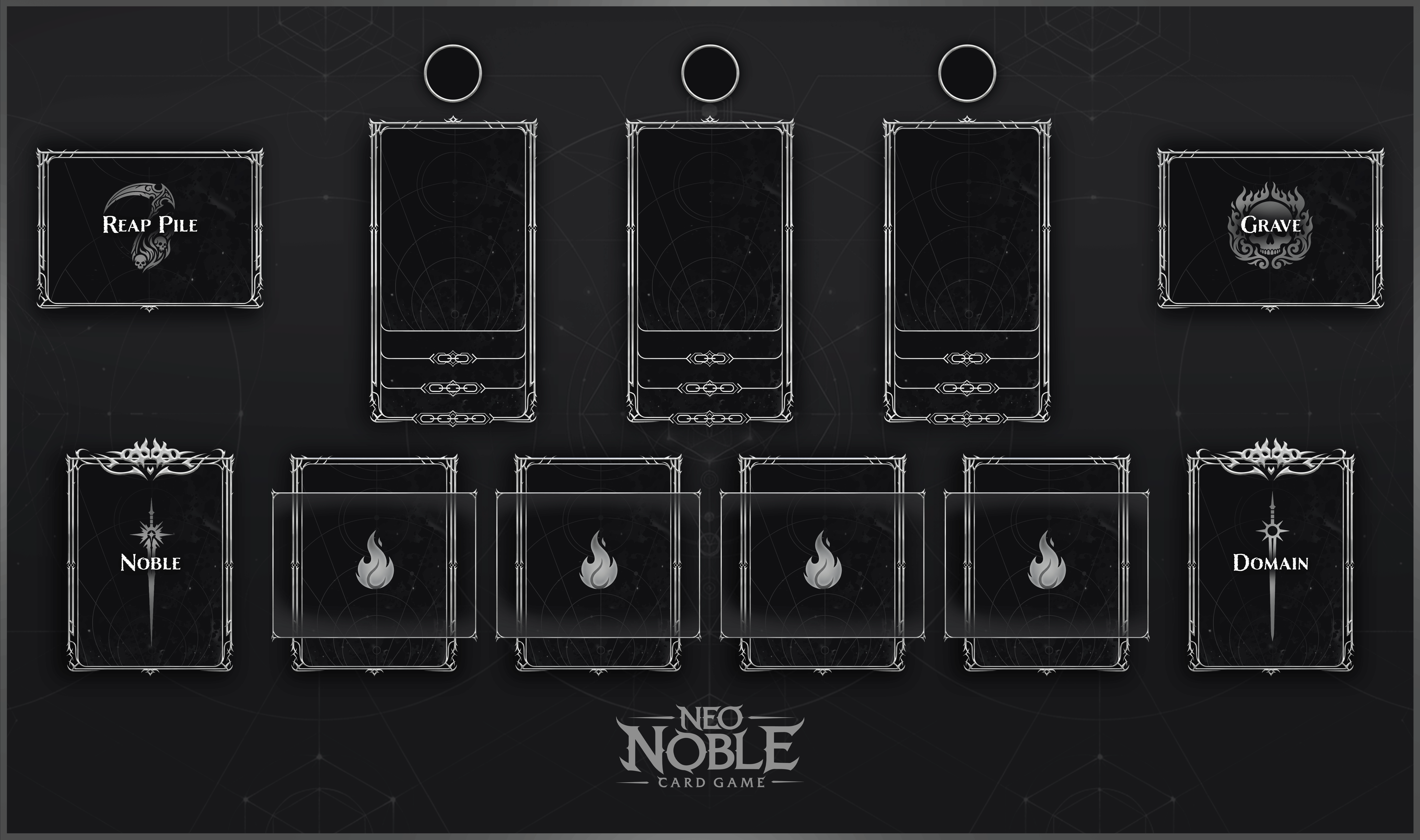
1. Noble Slot
Where your Noble card is placed at the start of the duel
2. Channel
Where cards are placed face-down as resources before being drawn
3. Domain (Deck)
Your deck of cards that you draw from during the duel
4. Battlefield
Three planes (left, middle, right) where cards battle for dominance
5. Dominance Zone
Three circled slots above each plane tracking which player has the highest total Resolve
6. Grave
Where cards are placed face-up after being discarded or defeated
7. Reap Pile
Shield zone where the top three cards from your deck are placed face down as Guards at the start of a duel
8. Banish Zone
Unmarked zone off the play area where cards are removed from the current duel
9. Shade Zone
Unmarked zone for shades, kept within reach for fluid gameplay
10. Reserve Deck
Sideboard used for best-of-three format (must remain visible to opponent)
Prior to dueling, both players must construct a 40-card deck (your domain) or use a preconstructed deck.
To start, choose a Noble with effects and a playstyle that resonates with you. Then forge bonds with Arbiters and Errants until you have assembled your 40-card deck within these guidelines below:
Maximum two different Fates, with up to 20 cards of the second chosen Fate in your main deck. The 3 copy maximum rule still applies.
Any number of Fates. The 3 copy maximum rule still applies.
Above are our official formats, but sometimes the best rules are the ones you write yourself! Gather your friends, draft house rules, and invent your own formats. Above all: have fun.
Prepare for battle! Setting up a game of Neo Noble is quick and straightforward - you'll be ready to duel in just a couple of minutes.
 Noble's Bargain Coin
Both players may mulligan up to 2 cards from their starting hand:
Gif loop of game setup sequence
Channeling is the primary method of gaining Souls, which are the game's resources used to summon cards and activate effects.
Cards can be in one of two states while in the Channel Zone:
 ReadySpent
Face-up cards may have special behaviors when Channeled - watch out!
Dominance represents control over a plane's spiritual energy, which can be harnessed to generate Souls. Players compete for Dominance by maintaining the highest total Resolve in a plane.
There are exactly 3 Dominance coins in the game - one for each plane. Each plane has a corresponding Dominance tracker (coin) which begins in a neutral position between both players' playmats.
Whenever a card enters a plane from outside the battlefield—from your hand, deck, Reap Pile, Grave, or when created on the field (such as a Shade)—and all entry effects have resolved, perform a Dominance Check in that plane. The plane/player with the highest total Resolve either gains, maintains, or steals Dominance from its current position. When gained, Dominance immediately flips to its spent side unless otherwise stated, then readies during your End Phase.
During your Action Phase, you may voluntarily relinquish Dominance in a plane you control to generate 1 Soul. The Dominance coin returns to the neutral position.
Many card effects interact with Dominance states and changes. Consider carefully when to fight for, maintain, or relinquish Dominance in each plane.
Summoning your cards to the battlefield and linking their spirits is the heart of Neo Noble's gameplay. What powerful synergies can you discover through careful positioning and layering?
Cards are considered "cards" when in your deck, hand, or other zones. Once a card enters the battlefield face-up, it becomes a "Spirit" - a manifestation of its power on the field.
Your Battlefield consists of three distinct lanes representing areas of influence:
Each linked Spirit adds its Power and Resolve to the plane's total strength
Only the topmost Spirit's effects are active in a linked stack
Each plane can hold up to 4 linked Spirits unless modified by card effects

Consider carefully which Spirit to place on top of a link - its effects will be the only ones active in that stack!

When the active spirit in a plane is destroyed, the stack beneath it Shatters. Cards in that stack are destroyed one at a time from top to bottom until all cards in that stack are destroyed.
Errants are destroyed and sent to their owner's Grave.
Shades are destroyed and Banish.
Arbiters have Shatterproof. When a stack Shatters, stop destroying cards when an Arbiter is reached. That Arbiter and all cards below it are not destroyed. That Arbiter gains Stun until its controller's next turn.
A Stunned spirit remains face-up and, until its controller's next turn, has no behaviors, effects, or counters and has 1 Power and 1 Resolve.
Nobles possess unique effects that define their playstyle and strategy. These powerful effects are always active or accessible while your Noble is in play.
Effects can be found on Arbiters, Errants, and even Shades. Some cards may have no effects at all, relying purely on their Power and Resolve stats.
| Effect Activation Types | |
|---|---|
| ON SUMMON Triggered when summoned. Mandatory unless stated "you may". | |
| MANIFEST Once per turn effects for Nobles and Active Spirits. | |
| ONGOING Passive effects active while card is face-up. | |
Behaviors are special rules that dictate how cards interact with the game state, similar to keywords in other games. These can appear on any card type.
| Unique |
|---|
| SEEKER (If this card is summoned in an empty plane, you may Channel a card.) |
| Shared |
|---|
| HASTE (You may summon this face-up card from your Channel.) |
| Universal |
|---|
| BRITTLE (Destroy this card after activating its effect.) |
A player's turn consists of three distinct phases: Income Phase, Action Phase, and End Phase.
The Income Phase is where you'll set up your strategy for the turn ahead. During this phase, you activate start-of-turn effects and Channel the top card of your deck to gain resources for the turn.
Your Income Phase begins with the opportunity to activate ONGOING effects from any face-up cards under your control. These can range from generating resources to creating Shade spirits.
ONGOING effects are optional unless stated with "You must".
Declare your card's named effect along with it's rule text, followed by its target(s), action(s), and resolution.
When multiple ONGOING effects are available, you determine their activation order.
ONGOING effects may count as activations, allowing cards with specific REACT triggers to respond even during the Income Phase.
As part of your Income Phase, Channel the top card of your deck face-down in your next available Channel slot (as outlined above in Channeling).
Each player has 4 available slots to store and Channel their cards.
Place the top card of your deck face-down in the next available slot in your Channel Zone.
Cards enter Ready (upright) and can be spent for 1 Soul, becoming Spent (sideways) after use.
The Action Phase is where you'll deploy your tactics and attempt to outwit and overpower your opponent by spending resources gathered during the Income Phase. During this phase, you can draw additional cards, activate face-up card effects, and summon and send your cards into battle.
Summoning is the act of paying a card's cost to play it onto the battlefield. There are three types of Summons: Normal, Tribute, and React. Cards may be summoned from any zone outside of the battlefield's three planes (hand, Channel, Deck, Grave, Reap Pile, and Banish Zone).
See Linking Spirits under CORE MECHANICS for more information on summoning cards into the battlefield.
See Dominance under CORE MECHANICS for more information on when entering a plane triggers a Dominance Check.
Pay souls by turning Channel cards sideways, spending lingering souls, relinquishing Dominance, etc.
Place as active (top) spirit in any plane unless stated otherwise
Pay alternate cost stated in TRIBUTE— text instead of Soul Cost (e.g. TRIBUTE—Discard a GhostBound card from your hand.)
Place as active (top) spirit in any plane unless stated otherwise
Can be summoned outside your turn when conditions in REACT— text are met (e.g. REACT—When your opponent attacks.)
Still requires paying either Soul Cost or Tribute Cost
Cards with REACT— can cause certain effects to chain. In these cases, resolve the most recent card effect first (i.e. "last in, first out").
Empty planes have a Resolve  of 0, leaving them wide open. Consider carefully before summoning - even a single spirit adds Resolve, but a weak one may not be enough to defend the plane.
Activate powerful once-per-turn effects from your Nobles and active Spirits.
Activate the once per turn effect of a face-up Noble or effect of an active spirit with the MANIFEST activation type
Some MANIFEST effects have an additional cost to use it's one-time effect (example: MANIFEST: Pay 1 Soul; you may reveal a face-down card in any player's Channel, then Channel 1 card.)
Cards with the same name can each activate their MANIFEST effect once per turn unless otherwise stated
If you control at least one card in a plane, you may challenge the opposing plane in a battle. If a battle action is taken, the battle must fully resolve before another action can be taken.
Choose a plane where you control at least one card. Pay 2 souls to declare an attack and challenge the opposing plane's Resolve
Your plane's total Power must exceed the opposing plane's total Resolve by at least 1 to succeed
You may only attack in each plane once per turn unless otherwise stated
The defending player may discard any number of cards from their hand to their Grave to increase their defending plane's total Resolve (+1 per card discarded)
Must be declared after the attacking player declares their attack (i.e. stating "yes" or "no" to blocking the attack)
If the defending player chooses to block, they must discard to make their plane's total Resolve greater than or equal to the attacking player's total Power to block
If attack succeeds, destroy defending active spirit. The top Guard from the defending player's Reap Pile moves to their Channel face-up and ready. If their Channel is full, that Guard moves to their hand instead.
If you successfully attack while your opponent has zero cards in their Reap Pile, you achieve Reap Victory and win the duel
If the attack is not successful, the battle resolves and new actions can be taken
Building up to a battle is an intense game of cat and mouse. Remember, you only need to overpower your opponent's side by 1 point - balance your offense and defense wisely to reap before being reaped yourself.
Scouting lets you claim uncontested neutral Dominance during your Action Phase. Pay 1 Soul to claim neutral Dominance in a plane where you control at least 1 face-up spirit.
Pay 1 Soul to Scout a single plane. This cost is paid per plane, not once for all planes.
You may Scout any plane where you control at least 1 face-up spirit.
Scout only claims neutral dominance coins; it does NOT steal dominance from your opponent.
Focus is available only if you have taken no Actions this phase. When you Focus, Channel 1 card and Draw 1 card, then proceed directly to your End Phase.
Channel an additional card from your deck (enters readied)
Draw the top of your deck to your hand
Focus is only available if you took no Actions this phase. After Focusing, proceed directly to your End Phase
Focus can be a powerful tool when you need to build resources quickly or draw additional cards.
The End Phase is where you'll clean up your board prior to passing turn priority to your opponent. During this phase, you'll have one last chance to activate end-of-turn effects before you manage your excess hand size and reset your main resources.
Your End Phase begins with the opportunity to activate ONGOING effects from any face-up cards under your control. These can range from generating resources to creating Shade spirits.
ONGOING effects are optional unless stated with "You must".
Declare your card's named effect along with it's rule text, followed by its target(s), action(s), and resolution.
When multiple ONGOING effects are available, you determine their activation order.
ONGOING effects may count as activations, allowing cards with specific REACT triggers to respond even during the End Phase.
Harvesting is the optional act of drawing all cards from your Channel into your hand, which replaces a player's typical draw phase similar to other games.
All cards are collected from your Channel Zone regardless of their state (readied or exhausted), regardless if there is 1 card or 4 cards.
Choosing when and when not to Harvest is crucial to long term victory. Players are encouraged to analyze their options in this moment similar to deciding a move in the game Chess.
During this step, you first lose any temporary souls that were gained during your turn and haven't been spent. Then, if you have more than 6 cards in your hand, discard cards until you have exactly 6 cards remaining.
Only temporary souls are lost; permanent souls remain
Soul loss occurs even if affected by card effects
You choose which cards to discard
Discarded cards go to your Grave face-up
If you have 6 or fewer cards, skip this step
Reset all cards in your Channel to their readied state and ready any Dominance you control that is face-down (in its spent state).
All exhausted channel cards become readied
Ready any Dominance coins you control
Players do not need to declare the end of their turn since this action signals to their opponent that it is now their turn.
To win a duel by Reaping souls from your opponent, you must successfully attack while they have zero cards in their Reap Pile (a direct attack on their Noble)!
Your Noble's shield zone. The top three cards from your deck are placed face down in this zone at the start of a duel and act as your Noble's "Guards"
Cards in this zone are hidden knowledge for both players unless otherwise stated by a card effect
Cards can be swapped or added from this pile if the effect allows
Your Reap Pile acts as your Noble's shield - protect your Guards to prevent your opponent from achieving a Direct Attack!
While reaping four spirits is the primary path to victory, there are other ways to achieve victory in Neo Noble.
Opponent concedes the match
Fulfilling a card's alternate win condition
Opponent is forced to move a card from their Domain while empty.
 Soul CostThe amount of souls required to summon a card or activate an effect. |
 PowerA card's offensive strength. Can go below 0 an infinite amount. This value is used to overpower the Resolve of an enemy card in battle. |
ResolveA card's defensive strength. Can go below 0 an infinite amount. Overpowering this value by at least 1 point will destroy and Reap the spirit in battle. |
ShatteringIndicates this spirit will be destroyed when a stack Shatters. Found on Errants and Shades. |
EarthBoundA brand given to Souls bound to reincarnate back to their home world. EarthBound cards are influenced by the Channel, cycle, and go wide on the battlefield. |
GhostBoundA brand given to Souls bound to be cast into the Void as ghosts. GhostBound cards are influenced by the Grave, bounce, and revealing what's hidden on the board and hand. |
HellBoundA brand given to Souls bound to an eternity of torment. HellBound cards are influenced by the Reap Pile, power, and winning battles at any cost. |
HeavenBoundA brand given to Souls bound to ascend in rapture. HeavenBound cards are influenced by Dominance, protection, and playing high cost cards. |
Need help with specific rulings or interactions?
 In Collaboration With
DEV TEAM: Aaron Beedle, AveZebra, James Grey Morgan, Joey Aaron, Mikolaj "Mideanon" Wiszniewski
GAME WRITER: Nick Jones|VISUAL DEVELOPMENT LEAD: José Parodi
ARTISTS: Bráulio Gregorio, Bruno Barros, Cristina Mogollón, Daniel Cunha, Hamza El Faroki, Joëlle, Pedro Mancini, Rainer Petter, Xena Rin
STUDIO PARTNERS: Rayven Studios, RetroStyle Games
CONTRIBUTORS: Olayinka Henrietta Edun, Color Current, Void State Media
WEBSITE BY Jared Guinn & Tom Lorenzo
©2025–2026 Jagu Games. All rights reserved. All trademarks referenced here are the properties of their respective owners.